
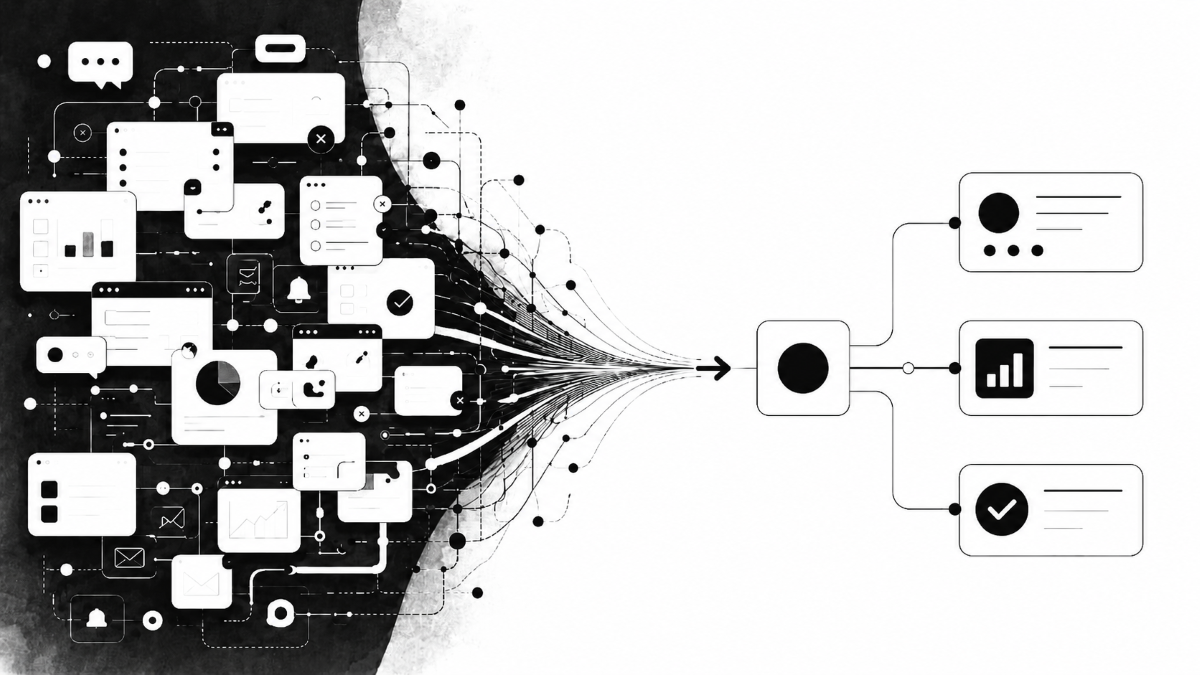
The Paradox of Tool Saturation
Something counterintuitive is happening inside organizations across industries. Even after major investments in workplace technology, including AI copilots, collaboration platforms, project management dashboards, automated workflows, and real time communication tools, many teams feel less aligned, less focused, and less able to execute on the work that matters most.
Recent reports on digital workplace trends shaping enterprises in 2026 notes that the average knowledge worker now navigates dozens of platforms daily. At the same time, alignment and prioritization challenges continue to grow, which suggests that the issue is less about access to technology and more about the way work is structured across it.
What Platform Sprawl Costs
The hidden cost of tool proliferation rarely appears on a dashboard, but it builds quickly inside teams. Every new platform creates another place to check, another context to maintain, and another step before decisions can happen.
This fragmentation creates cognitive overhead: the mental load of tracking where information lives, which channel owns the conversation, and how to piece together priorities from disconnected sources. The impact shows up in predictable ways:
- Decision making slows as people search across systems and threads.
- Context switching breaks focus and increases fatigue.
- Priority confusion grows when every request feels urgent.
- Critical context gets lost when tools are monitored inconsistently.
Together, these costs drag down performance and make it harder for leaders to separate real progress from visible activity.
The New Competitive Divide
The organizations turning friction into execution share a common operating pattern. They create consistent spaces where teams can talk honestly about priorities, progress, and blockers in real time, then use those conversations to make decisions that people can act on.
These spaces may take the form of recurring team sessions, dedicated alignment rituals, or focused working groups. Whatever the format, they function as operational infrastructure because they give teams a reliable rhythm for surfacing reality, clarifying tradeoffs, and maintaining shared momentum.
Strong teams also practice prioritization discipline. They define what matters most, revisit those choices as conditions change, and prevent every new input from becoming an equal claim on attention.
Turning Friction Into Execution
The organizations that will define the next era of work will be the ones that cut through noise, protect focus, and create the conditions for clear execution. As the digital workplace becomes more complex, that discipline is becoming rare, which makes it a durable advantage.
The path forward begins with building the right environment. People need to know what matters, feel safe naming what is actually happening, and have enough structure to move forward together without being pulled apart by constant noise.